
Stunt.Blog Prices One Bad SAG Day at $5,736 a Performer — and Argues the Sequence Should Have Been Bid in Europe
- A new analysis prices one stunt performer's long SAG-AFTRA day at $5,736, not the $1,283 minimum.
- Fifteen performers on that same day reach $86,045, mostly stunt adjustments and meal and rest penalties.
- It argues producers should price the same sequence with European crews before the schedule is locked.
Posted: November 4, 2026
The piece is built around one worked example, and it is a day any coordinator will recognise. A day-hired adult performer on the standard SAG-AFTRA theatrical agreement draws the minimum that took effect on 1 July 2026: $1,283. The gag is a hard impact on concrete, planned for two or three takes and pushed to five by camera and acting problems. Two stunt adjustments are assumed at $1,500 — and the article is explicit that this figure is its own assumption, not a published union tariff.
From there the arithmetic does the work. Base plus adjustments is $2,783, which clears the theatrical money break of twice the daily minimum, $2,566, so overtime computes off $2,566 ÷ 8 = $320.75 an hour. The call runs 08:00 to 19:00 with no qualifying meal break, so the ninth, tenth and eleventh hours all pay time-and-a-half — $1,443.38 — and the meal violations ladder from $25 up to $75 a tier, totalling $610. The next first call is 06:00, eleven hours after wrap and one short of the studio-zone twelve, which adds a forced call of $900. One performer, one day: $5,736.38. Fifteen performers on the same terms: $86,045.70, of which $22,500 is adjustments and $22,650 is meal and rest violations.
Ferdi Fischer, whose SlamArtist.com network publishes the blog, sets a practitioner's range beside the worked example: adjustments running from a few hundred dollars to several thousand, and $15,000, $20,000 or $30,000 on exceptionally demanding or high-risk vehicle work. Again, not a price list — a description of what actually gets negotiated on the day.
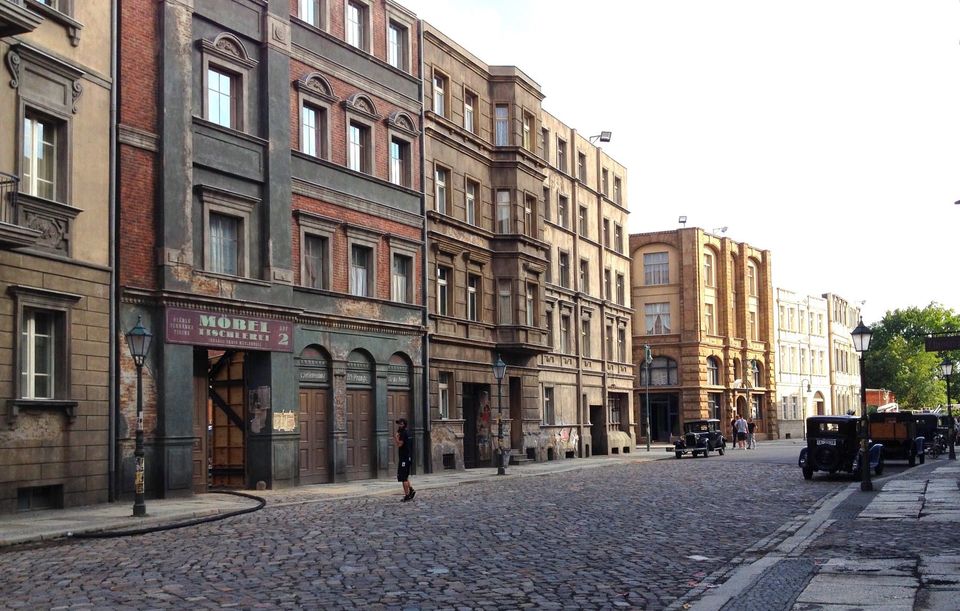
The European case rests on what gets built before the expensive shooting day arrives. The analysis points at “John Wick: Chapter 4,” where the Berlin nightclub was built as a multi-level environment with water and fire effects inside Kraftwerk Berlin and the rest at Studio Babelsberg, and where Chad Stahelski contacted fight choreographer and stunt coordinator Laurent Demianoff about a year before the shoot. A core of six martial artists grew to roughly fifty American, German, Japanese and French stunt professionals, worked out over video calls with Los Angeles before anyone assembled in Berlin. It points, too, at The Third Floor's London team developing the Budapest chase beats on “Black Widow” alongside the stunt and shooting units.
The labour side is the practical part for anyone building a crew. EU citizens generally work across Germany, France, Spain and Hungary without a work permit, subject to posting rules; London runs on its own arrangements, including the UK Creative Worker visa. The EU Working Time Directive sets breaks after more than six hours of work and eleven consecutive hours of daily rest as minimums, implemented nationally. Hungary's National Film Institute describes a 30% production incentive; on the article's own example a 1,000,000 budget yields a 225,000 rebate — 22.5% of the whole budget — with a 2026 collection-account limit and a six-month window to start principal photography after the registration decision.
The ask aimed at producers is a scheduling one rather than a price one: get the European proposal in while rehearsal, build location and camera integration are still open, not after the sequence is locked.
Worth knowing who is talking. STUNT.BLOG is part of the SlamArtist.com group, which sells stunt, action-direction and WarpCam® camera services, and the article discloses that this is connected coverage.
Source: STUNT.BLOG — Why Hollywood Should Bid Its Next Action Sequence in Europe
Learn more on IMDb: Chad Stahelski