
“Project Hail Mary” Ruled Out the Vomit Comet and Flew Ryan Gosling on Wire Rigs and a Rotating Harness
- "Project Hail Mary" wanted to shoot its zero-gravity scenes on a "vomit comet" plane that briefly makes people weightless.
- The spacecraft sets were too big to fit in the plane, so Ryan Gosling worked on wire rigs and a rotating harness instead.
- When a shot still looked like an actor hanging rather than floating, artists repositioned his limbs and added drifting objects.
Posted: October 18, 2026
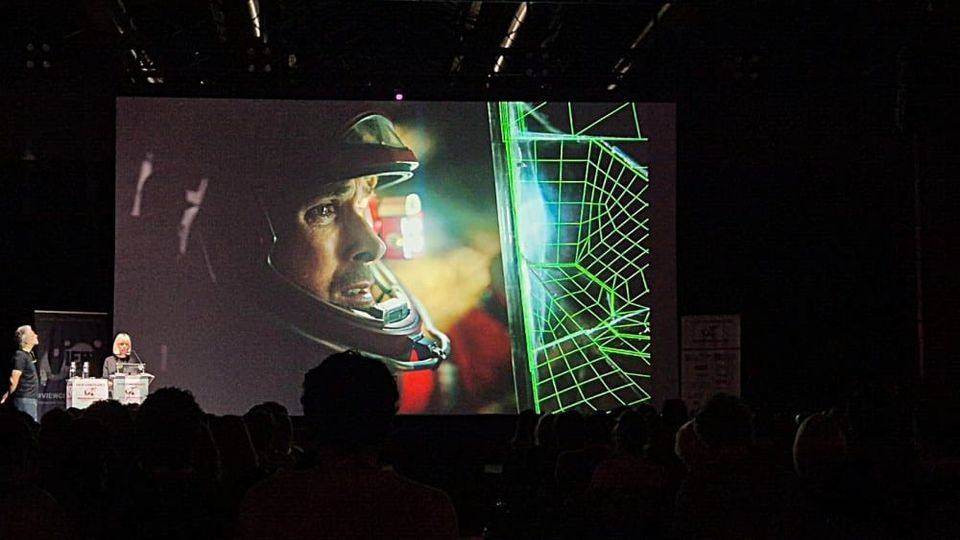
Speaking at View Conference in Turin, Oscar-winning visual effects supervisor Paul Lambert said zero gravity was the single hardest problem on the Phil Lord and Christopher Miller space picture. The department pushed hard for parabolic flight — the "vomit comet" — which buys roughly twenty seconds of genuine weightlessness per arc. The spacecraft interiors, built as full practical sets with working panels, were far too large to load into an aircraft. That ruled out the one approach that would have given the performer real float, and pushed the whole sequence back onto rigging.
What replaced it was wire work: Gosling on rigs, including a rotating harness that let him turn through a long axis rather than simply hang off a single point. Lambert said the actor committed to performing his own stunt work, including the more demanding spacewalk material. Anyone who has run a body on wires knows the problem that follows, and Lambert named it exactly — pulling the wires out in post is the easy half. The hard half is that a suspended body reads as suspended. Weight finds the low point. Arms settle, the pelvis drops, the spine stops being neutral. The effects team ended up adjusting the position of Gosling's legs, arms or torso shot by shot, and seeding drifting objects into frame, so the eye had something unweighted to compare him against.
The same bias toward practical capture ran through the rest of the shoot. DP Greig Fraser used an infrared-modified camera, programmable IR lights and water run in front of the lens for some of the stranger imagery, and the production shot burning fireballs, liquids, lasers and ferrofluid as starting points rather than building them from scratch. Rocky, the alien, was performed on set by James Ortiz and a puppeteer team across three practical builds including an animatronic; co-supervisor Mag Sarnowska said roughly half the finished Rocky shots are the puppet and half are CG trained to mimic the puppeteers. On a show that shot no green screen, the rigging department and the VFX department are solving the same shot from two ends.
Learn more on IMDb: Project Hail Mary (2026)